A marketplace page shows a floor price, a volume figure and a number of owners. Each of those numbers can be read in a good way or a misleading way, and some of the most important facts are not on the page at all. This guide gives five checks for a beginner and runs them on two well-known Ethereum collections, Pudgy Penguins and Azuki, using data read on 23 November 2026. The two were chosen because they are large, long-running and easy to verify, not because we recommend them. We did not buy anything.
What to know first
- An NFT collection is a smart contract that records who owns each numbered item. The picture or file is usually stored elsewhere and the contract points to it.
- The floor price is the lowest price at which any item in the collection is listed. It is not the price you can sell every item for.
- Volume is the amount traded over a period. Low volume means few buyers, even if the floor looks high.
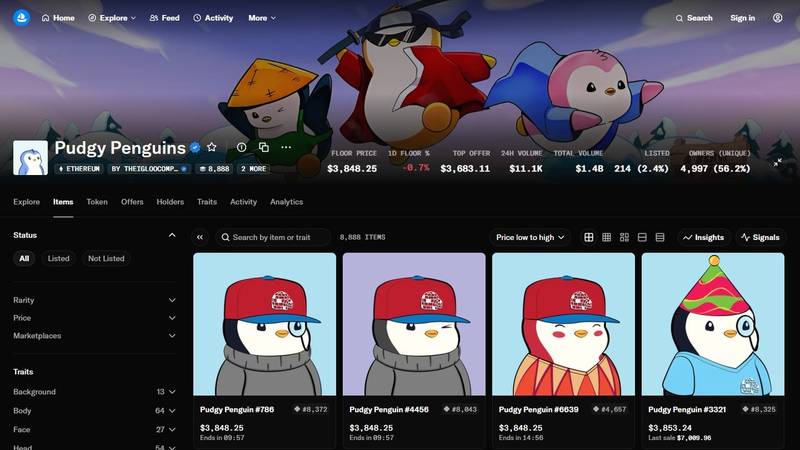
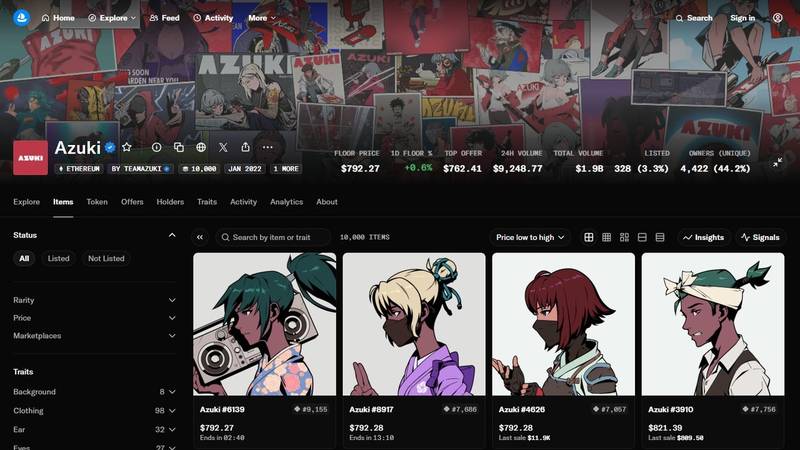
- On 23 November 2026, OpenSea showed Pudgy Penguins at a floor of about $3,848 with 24-hour volume of $11.1K, and Azuki at about $792 with $9.2K.
- Both collections still have a function in their contract code that lets the owner change the base address of the metadata. We found it by reading the code, and we did not see it used.
Our reading: a collection can look large and still be hard to sell. Check how much trades, who holds it and what the contract owner can do, before you look at the picture.
How we chose what to cover
Our search tool returned nothing in this session, so we used primary sources. We read the contract state of each collection from a public Ethereum node (name, supply, owner, token address format and a list of common admin functions in the compiled code). We sampled 400 random token IDs per collection and looked up their owners. We read market data from OpenSea's public collection pages (captured on 23 November 2026) and from CoinGecko's public NFT API on the same day. NFTGo, Tensor and Magic Eden block automated browsers, and Etherscan and CoinGecko's web pages sat behind a bot check, so we did not use them. We did not test buying, listing or any wallet connection.
Terms used in this guide
| Term | Plain meaning |
|---|---|
| NFT | A token on a blockchain that records ownership of a unique item |
| Collection contract | The smart contract that tracks all items in one collection |
| Floor price | The lowest listed price in a collection |
| Top offer | The highest bid made for any item in the collection |
| Volume | The total value traded in a period, such as 24 hours |
| Unique owners | The number of different wallets that hold at least one item |
| Metadata | The data (name, image address, traits) that an item points to |
| Base URI | The address prefix from which a contract builds each item's metadata link |
| Wash trading | Trading with yourself to fake volume or push a price |
| Royalty | A percentage of a resale paid to the creator, if the marketplace enforces it |
Check 1: the contract and its owner
Start with the contract, not the artwork. Find the contract address on the marketplace page, then read basic facts from a block explorer or, as we did, a public node. Ask: how many items exist, who is the owner of the contract, and what can the owner change?
| Fact (read 23 Nov 2026) | Pudgy Penguins | Azuki |
|---|---|---|
| Contract address | 0xBd3531dA5CF5857e7CfAA92426877b022e612cf8 | 0xED5AF388653567Af2F388E6224dC7C4b3241C544 |
| Total supply | 8,888 | 10,000 |
| Contract owner | An ordinary wallet (no code at the address) | A small contract (171 bytes of code) |
| Metadata pointer | IPFS address | IPFS address |
| Owner can change the base URI (function present) | Yes | Yes |
| Owner withdrawal function (present in code) | Yes ("withdrawAll") | Not found |
| Standard royalty interface (ERC-2981) | Not supported | Not supported |
What these mean in plain words:
- The owner of Pudgy Penguins is a single wallet. That is normal for older collections, but it means one key controls the admin functions. Azuki's owner is a small contract. Contracts of that size are often proxies for a shared wallet, but we did not confirm that, so we do not claim it is a multisig.
- Metadata on IPFS is a good sign. An IPFS address is based on the content, so a file at that address cannot be silently swapped. The risk is that the owner can set a new base address. In both cases the function is present in the code. We did not see it used, and we did not read the history of the contract.
- No ERC-2981 means the royalty is not written in the contract. Royalties then depend on the marketplace's own rules, which we did not read.
Check 2: floor price and volume
Read the floor together with volume and the number of listings.
| Metric (23 Nov 2026) | Pudgy Penguins | Azuki |
|---|---|---|
| Floor price | $3,848 (2.23 ETH) | $792 (0.46 ETH) |
| Top offer | $3,683 | $762 |
| 24-hour volume | $11.1K | $9.2K |
| All-time volume | $1.4B | $1.9B |
| Items listed | 214 (2.4%) | 328 (3.3%) |
| Floor times supply | about $34.2M | about $7.9M |
Three simple calculations help:
- The gap between floor and top offer shows what an instant sale costs. For Pudgy Penguins it is about 4.3% and for Azuki about 3.8%, before marketplace fees, which we did not read.
- Volume against floor times supply. At the 24-hour pace, daily volume is about 0.03% of Pudgy's floor-times-supply value and about 0.12% of Azuki's. Floor times supply is a headline figure, not a value that anyone could cash out, because selling many items would push the price down.
- All-time volume versus today. Pudgy's $1.4B and Azuki's $1.9B show past activity. Today's $11.1K and $9.2K show how thin trading is now.
CoinGecko's API returned the same floor and holder figures for both collections (floor 2.23 ETH and 0.46 ETH, 4,997 and 4,422 unique addresses), so on these two the marketplace and an independent aggregator agree.
Our reading: both collections have large histories and small daily trading. A buyer should plan to hold, not to flip, and should expect a gap on exit.
Check 3: who holds the collection
A collection held by thousands of different wallets is harder for one party to move than one held by a handful. Marketplaces show a "unique owners" figure, but it hides how the rest is split.
OpenSea showed 4,997 unique owners for Pudgy Penguins (56.2% of its 8,888 items) and 4,422 for Azuki (44.2% of 10,000). CoinGecko's API gave the same two counts.
To look closer, we picked 400 random token IDs in each collection and looked up who owns them:
| Sample of 400 random items | Pudgy Penguins | Azuki |
|---|---|---|
| Distinct owners in the sample | 344 | 326 |
| Largest single owner in the sample | 9 items (2.3%) | 11 items (2.8%) |
| Is the largest owner a contract? | Yes | No, an ordinary wallet |
A 400-item sample is small, so the percentages are rough and could be a point or two off. It does not tell us the full holder list. It does show that neither collection looked concentrated in a single wallet in our sample. The largest owners in the Pudgy sample included contracts, and one contract address held items from both collections. Contracts that hold NFTs are often marketplace escrow or vault contracts, but we did not identify this one, so we cannot say who is behind it.
What to do in practice: open the "Holders" tab on the marketplace and look at the top 10. Ask whether they are people, marketplaces or the creator.
Our reading: both collections looked broadly spread in our sample. The thing we could not see is how many of the "unique owners" are inactive wallets.
Check 4: signs of wash trading
Wash trading is trading with yourself to make volume or prices look better. It is hard to prove from a summary page, but some signs are worth checking:
- Volume far above the usual with no change in owners. If volume jumps and the owner count does not, the same wallets may be trading among themselves.
- Sales at prices far from the floor. Repeated sales much above the floor, between the same wallets, can set a false price.
- A buyer and seller who are the same person. Look at the activity tab for wallets that appear on both sides.
- Trades funded from one wallet. If new buyers all received funds from the same source, they may not be independent.
We did one rough test on the data we had. CoinGecko's API showed three sales for Pudgy Penguins in 24 hours with 6.48 ETH of volume, an average of about 2.16 ETH, close to its floor of 2.23 ETH. For Azuki it showed 11 sales and 5.4 ETH, an average of about 0.49 ETH against a floor of 0.46 ETH. Averages close to the floor are what we would expect from normal trading. They do not prove it, because we did not open individual trades or check the wallets involved.
Check 5: royalties, listing terms and look-alikes
Before you pay, check the following:
- Is it the real collection? Copycats use the same artwork. Compare the contract address on the marketplace with the one on the project's official site or a second source. We checked ours against CoinGecko's record, and the addresses matched. Both pages also showed a verified badge.
- Which fees apply? Marketplace fees and creator royalties differ by platform and by collection. Neither collection supports the on-chain royalty standard, so any royalty depends on the marketplace's rules. We did not read the fee terms of OpenSea or any other marketplace.
- What are you approving? Listing or buying may ask your wallet for permissions. Read the prompt before you sign. We did not connect a wallet for this article.
- Can you exit? Check the number of listings and the gap to the top offer, as in Check 2.
A short checklist
- Find the contract address and compare it with the official source.
- Read the supply, the owner and whether the owner can change the metadata address.
- Check where the metadata lives. IPFS is better than a private server.
- Compare the floor, top offer, 24-hour volume and listing count.
- Look at the top holders and see whether they are people, marketplaces or the creator.
- Look for wash trading signs in the activity tab.
- Check fees and what your wallet is asked to approve.
Our reading
- The picture is the least useful part of the check. The contract, the owner and the trading data matter more.
- Both collections have long histories, but in the 24 hours we looked at, trading was thin compared with their headline size.
- The main contract-level risk we found is that the owner can still change the metadata address. We have no sign it has been used, and we did not check.
- Being "verified" on a marketplace tells you the page is the real one. It does not tell you the price is fair.
What we did not check
- We did not buy, list, or connect a wallet, so we did not test fees or approvals.
- We did not read the contract's transaction history, so we cannot say whether the owner has ever changed the base URI or withdrawn funds.
- We did not read the marketplace fee or royalty terms.
- We sampled 400 items per collection. We did not pull the full holder list.
- We did not open individual sales to test for wash trading. We did not check wallet funding sources.
- NFTGo, Tensor, Magic Eden, Etherscan and CoinGecko's NFT web pages blocked our automated browser, so we used the OpenSea pages, the CoinGecko API and direct reads from an Ethereum node.
- We did not check CryptoPunks. An earlier holder count for it looked wrong, so we left it out.
FAQ
How do I know if an NFT collection is legit?
Check that the contract address matches the official source, read who owns the contract and what it can change, and look at the trading data and holder spread. None of these proves a collection is safe.
What is the floor price?
It is the lowest price at which any item in the collection is listed for sale. It is not the value of every item.
Is a high floor price a good sign?
Not on its own. Look at volume and the gap to the top offer. A high floor with little trading can be hard to sell into.
What is wash trading in NFTs?
It is trading with yourself or a linked wallet to create fake volume or set a high price. Signs include repeated sales between the same wallets and volume spikes without new owners.
What does it mean when the owner can change the base URI?
It means the creator can point the collection at a different metadata address. That can be used for legitimate updates or, in the worst case, to change what items show. We found the function in both contracts and did not see it used.
Where are NFT images stored?
Often on IPFS, which is content-addressed, or on a server the creator controls. Check the metadata address in the contract.
Do NFTs have to pay royalties?
Not by default. Royalties depend on the contract standard and on each marketplace's rules. Neither collection here supports the on-chain royalty standard.
Is this a recommendation to buy Pudgy Penguins or Azuki?
No. They were used as examples. This is not financial advice.
This article is for information only and is not financial or investment advice. Data was read on 23 November 2026 from a public Ethereum node, OpenSea and CoinGecko, and will have changed since.